Showing posts with label tart. Show all posts

Thursday, 15 December 2011

Ginger brûlée tarts


Photo credit: The Quiltmaker


The head notes to this recipe in Bourke Street Bakery cookbook says these tarts, especially their fillings,  are one of the most challenging items in the book, so how could I resist? The challenges I faced were more to do with locating my tiny loose-bottomed tart tins (I found two, with several extra bases), remembering to replenish my stocks of cinnamon quills and achieving an evenly browned rather than spotted blackened crust with my blowtorch. 

Given the lack of tart tins (the recipe provided quantities for 20), and the warning about their difficulty, I decided to treat this as a practice attempt and made only four. I also used leftover sweet shortcrust pastry rather than making the recipe in the book, which I’ll do for the real thing.

They were fabulous, even with their charred edges and acrid sugar. I do love a good masala chai, and these were inspired by chai on the author’s travels through the Himalayas.

 Adapted from the larger quantity in Bourke Street Bakery, pp264–5

Note: don’t get up the morning of a dinner party expecting to whip these up for dessert! They need to be started two days ahead, or you might get away with one if you skimp on either or both the infusing and custard-chilling.

145mL pouring cream
2cm piece of ginger, finely sliced
1 cardamom pod, bruised
½ cinnamon stick
2 egg yolks
20g caster sugar, plus more for dredging and burning later
small chunk sweet shortcrust pastry, enough for lining 4 8cm tart tins
chopped pistachios for decorating

Heat the cream with the ginger, cardamom and cinnamon stick until it comes to the boil. Pour into a container, cover and refrigerate overnight.

Reheat to simmering point, then set aside.

Whisk egg yolks, then add sugar and keep whisking until the sugar has dissolved. Strain the spices out of the warmed cream, which is then whisked with the yolks and sugar to combine. Put the bowl over a saucepan of simmering water (which mustn’t touch the base of the bowl), and keep whisking until your arm protests bitterly and the mixture is thick enough for tracks to be left in the wake of the whisk. 

This’ll be the most boring ten minutes of your life, so keep a companion handy to talk to and don’t be tempted to leave the whisking for even a few seconds. It’s okay to quickly change arms, but that’s all. Take the bowl off the heat and keep whisking for another minute or two to take some of the heat out of the mixture. Over the next hour, keep whisking every ten minutes until the mixture is totally cool. Press cling wrap to the surface to prevent a skin forming, and refrigerate overnight to set.

Line tart tins, freeze for 20 minutes, then blind bake at 200C for 20–25 minutes until golden. Allow to cool. Pipe the chilled custard into them, slightly overfilling, then scrape the custard flush with the top of the tart shell with a palette knife. Set in the fridge for 4 hours.

Sprinkle a teaspoon of caster sugar over the top of each tart and caramelise it with a blowtorch, somehow not blackening the tart crust edges as you do so. My caster sugar kept blowing itself into little balls that then became black blobs, but here and there were patches of perfect goldenness like an encouragement. Sprinkle a few pistachio fragments on top to serve, which I didn’t. Sprinkle pistachios, that is; I did serve, if marching into the Quiltmaker’s office and plonking it before her with a demand to sample and assess counts as serving. I think it does, and she didn’t seem to mind – she kindly took a photo in order to tweet about it, which I am now stealing as I neglected to take one of the finished item, as I am wont to do. Forget to take final pic, that is. And steal those of others to make up for my neglectfulness. But I consider the making of these tarts over several days penance enough.

So I shall make these again, probably in a quantity of ten, and serve with ice-cream. What ice-cream, I don’t know. Maybe a raspberry, as different enough to the custard and pretty besides, both advantages over a plain vanilla.

Monday, 28 November 2011

Nectarine frangipane tart


Too easy for words, not least with the pastry already made and frozen. I’m not sure who to attribute this to – I didn’t consult a book, but I wanted to put nectarines with amaretto. I like amaretto with just about anything, but especially nectarines. The tart formed itself around this from half-remembered bits and pieces, such as the cream from Dorie’s Chocolate Amaretto Torte.

4 nectarines, stoned and quartered
¼ cup sugar
a handful of amaretti biscuits, roughly crushed
splash of Amaretto

Combine in a bowl and set aside.

Allow the pastry to defrost at room temperature for about three hours. I left mine a bit long to roll out without sticking to everything, and it had to be sort of Play-Doughed into place in the tin. I then refrigerated it for half an hour before blind baking at 190C for about 20 minutes, for another ten without the beads, and then cooled it slightly. Meanwhile, on with the frangipane, which can be used for a multitude of tarts constructed along this line: pears, berries, apples, anything juicy best kept separate from the pastry base.

40g unsalted butter
50g sugar
50g almond meal
1 tablespoon plain flour
1 egg
½ teaspoon vanilla extract
pinch salt

Beat the butter into pale submission, add the sugar for a bit more beating, then mix in the rest of the ingredients. 

Spread this over the base, then overlap the nectarine quarters – this could equally be carefully arranged apple slices, or roughly strewn raspberries. For these amaretto-doused nectarines, I added even more freshly crushed amaretti biscuits I had handy.

Bake for about 45 minutes until the frangipane is golden and puffed up around the nectarines.

Whip about a cup of pouring cream with ¼ cup icing sugar, adding a splash of amaretto to taste or ¼ teaspoon almond extract for more intensity. 

Sunday, 30 October 2011

A-marketing and a-pickling and a-quiche-making

I hadn’t been to the Victoria Market for a while, but when E mentioned the sudden appearance of mangos about town I was down there like a shot. And what a transformation had taken place! There were verily mangoes, for like a dollar each, but also huge smooth eggplants at $2 a kilo instead of the shrivelled seedy $7/kilo offerings of a few weeks ago. Lebanese cucumbers were $1.50/kg, and so were delicate little zucchinis. I also loaded up with $1 strawberries, $5/kg swiss mushrooms, $1 bunches of baby asparagus, $2 silverbeet and loads of other stuff, and was back on the train to Parliament without even needing to go to the bank. Amazing what can be managed when spring has sprung and the Meat Hall and Deli is left for another more prosperous week – one that hasn’t seen expenditure on tax bills and flights to Europe, don’t you know. (It’s the one week of the year I can sound this sick-makingly yuppieish, and I’m trying it on for size.)

So because all this largesse wouldn’t fit into my narrow fridge, I had to think like a frugal pre-war housewife and preserve it and generally use it up some other way. I’ve never pickled anything before, but Alida Irwin’s all over it and has been known to ask for Fowler's Vacola sealing rings for Xmas. And so, unlike a pre-war housewife, I googled cucumber pickles and zucchini pickles and was rewarded with the Zuni Café’s zucchini. No sterilising, too easy with the food processor slicing attachment, and at last an opportunity to get out the Japanese pickle press.
The small pickle press could barely handle half a kilo of zucchini...
...but lo, it gave up its juices and reduced by half.

And then I made Dr Ben’s Cucumber Kimchi, scaling it down to three cucumbers.

 To use up some ingredients to eat sooner, I took a leaf out of Martha Stewart’s website, and another out of Dorie Greenspan’s Around My French Table, which I’ve done before, and sort of made up a leek and asparagus quiche. For the pastry case, I followed Martha Stewart’s Favourite Pie Crust just because it was there, with the addition of 15 minutes’ blind-baking in a 180C oven.

 a bit of butter
a clove or two of garlic, finely chopped
1 large leek or 2 small, sliced
2 bunches asparagus, sliced into 2cm bits
4 eggs
a cup of milk and cream, proportions as desired – I went half & half, then to the gym
2 tablespoons seedy mustard
some thyme leaves

Saute garlic in the butter until fragrant, add the leeks for a few minutes, then the asparagus for about 8 minutes until reaching tenderness but still bright green. Allow to cool slightly before adding to the waiting blind-baked pastry case.

Briefly whisk together with a fork the eggs, mustard, thyme, and milk/cream, and salt and pepper. Pour over the leek and asparagus, and put in the still-on 180C oven for about an hour or until it’s golden on top and only moves slightly when jiggled.

Meanwhile, the rest is earmarked for later – there will be Ottolenghi’s Mango Soba Noodles with Aubergine and Mango, a recipe beloved of the Quiltmaker, and Roasted Cauliflower with Dill from the same book, Plenty, and spanakopita, and an actual cooked breakfast of mushroom and spinach. And by Cup Day it will all be gone.

Saturday, 29 October 2011

Chocolate walnut salted-caramel tart


Let’s Go Bowling, my ex-boss, no less dashing now he has given up his pinstripes and adopted a Vespa, had a birthday last Saturday that involved a brace of Peking ducks at Old Kingdom. Because I am wise, and no Old Kingdom virgin, I knew this meant no dessert beyond the traditional fried ice-cream, so I leapt into the breach. His bachelor pad with its babe graffitied on the door and bikes hung alongside his artworks would admit no round, fluffy, girly confection, so it had to be something as severe-yet-sumptuous as a version of George Calombaris’s Walnut Salty-Caramel Chocolate Tart.

I have a narrow rectangular fluted tart tin that rarely sees the light of day, so few recipes there are scaled to it. By dusting off pi and hurting my brain a lot and getting frustrated – the study of research design and analysis this semester isn’t sticking at all – I worked out that a tart recipe catering to the usual round 25mm tin would be too much for this tin by about 40%. So then I made my life even harder by adapting two recipes for a caramel tart to fit – and to allow for the addition of praline and salt. 

Adapted from George Calomabris in Your Place or Mine? p54 and Gourmet Traveller

First up, I turned to George for his sweet pastry, which didn’t have the equal measures of butter and icing sugar that the GT version did. 

300g unsalted butter, at room temperature 
150g caster sugar vanilla bean, split lengthways, seeds scraped 
450g plain flour
1 egg 
salt
1 tbsp thickened cream

Beat butter, sugar and vanilla seeds on low until smooth and creamy – but not light and fluffy. Add flour, egg, salt and cream and mix until the dough forms a ball. George says at this point to divide the dough in half, freezing one portion for later use, but for my rectangular tin I divided it into thirds, formed oblongs to Gladwrap, and put two away in the freezer against the coming fruit season, while the dough to be used went in the fridge for an hour.

Meanwhile, I got George’s walnut praline ready by toasting 100g walnuts at 180C for about 8 minutes until lightly toasted, then rubbed in a tea towel to try to remove a bit of the skin, though it wasn’t entirely successful, and spread them over baking paper. 

Heat 110g caster sugar over a low flame, tilting pan occasionally but not stirring, for about 10 minutes, until sugar melts and dissolves into itself and a dark caramel forms – it helps to crush any lumps first, as they take longer to break down while the rest of it merrily burns. Pour over walnuts and leave to cool.

Cover a tea towel with baking paper. Fold over to enclose and pound with a rolling pin until roughly crushed. Set aside in such a place that it’s possible to refrain from eating most of it while getting back to the pastry.

Roll out the chilled dough between two sheets of baking paper until about 3mm thick, and line a greased 11x34cm rectangular loose-based tart pan with it, trimming and patching up where necessary – this is a very malleable and forgiving pastry. Stab all over with a fork and back into the fridge with it for half an hour.

Line the chilled pastry shell with baking paper and fill with pastry weights to blind bake for 15 minutes. Reduce oven to 180C, remove paper and weights and bake for another 15 minutes, until golden, and let it cool down a bit while moving on to the caramel sauce, for which I returned to GT rather than get involved in the 180g glucose and candy thermometers George suggests, but retained his addition of salt.

140g caster sugar
85mL water
50mL pouring cream
70g unsalted butter, coarsely chopped
a teaspoon Maldon sea salt (if I’d been using a regular non-flaky salt, I’d have reduced this by a third or half)

Combine sugar and water and stir over medium-high heat until sugar dissolves. Bring to the boil and cook for 10 minutes or until dark caramel; remove from heat, carefully add cream, butter and salt (be prepared for the molten mixture to spit) and stir. Return to heat and cook for 3 minutes or until smooth, then let cool slightly while scattering the walnut praline over the baked tart shell. 

Pour the salted caramel over that, and back in the fridge for an hour or two until such time as you make the chocolate ganache. 

110g dark couverture chocolate, chopped
40g cold unsalted butter, chopped
125ml thickened cream
2 tsp liquid glucose

Place chocolate and butter in a heatproof bowl. Bring cream and glucose to boil over medium heat. Pour over chocolate mixture and stand for 5 minutes. Stir until the chocolate melts and the mixture becomes smooth. Pour this velvety delightfulness over the caramel, tilt to even out, and chill for at least an hour, until firm. Serve at room temperature.

Monday, 12 September 2011

Alice B Toklas’s Tender Tart


Amid all the recipes in the Alice B Toklas Cookbook for chicken in a gallon of cream and 12 egg yolks, here’s a tart made by ‘sweet weak Kasper’, one of a vast progression of servants from whom Alice B Toklas drew most of her recipes. (Different times, that’s all I can say – though I seem to be increasingly on my own in not employing a house-cleaner still, given Gertrude Stein had to be waited on hand and foot and disliked seeing work being done, perhaps it was one way of keeping things slightly fairer for the devoted Alice B Toklas.) Unlike Gertrude Stein, Alice B Toklas uses commas, thank God, but no quote marks, and the meaning of a lot of her writing is difficult to untangle.

The recipe is also to be found in Gourmet Traveller, in which the top is latticed instead of solid, and a fluted tart tin is used – both of which I went with. But the quantities are quite different, higher ratio of butter and less sugar, and for the sake of the exercise I went with Alice B Toklas’s version, test-kitchenless though it probably was. It was delicious, but very sweet, which I imagine is why GT recommended serving it with goats milk yoghurt.

A TENDER TART
(p61 in my beautiful Folio Society edition with slipcase, velvety silver-topped pages and a line drawing of a painstakingly decorated carp on the cover and endpapers)

130g butter, 140g flour,* 1 egg yolk, blend with knives or pastry blender,** add only enough water to hold together, knead lightly, put aside in refrigerator.
***
Stir 2 eggs and 225g sugar for 20 minutes**** – do not beat. Add 1 teaspoon vanilla and 1 cup finely chopped hazel-nuts.

Roll out a little more than half the dough, place in deep pie plate, with detachable bottom, fill with egg-sugar-nut mixture. Roll out remaining dough and cover tart, press edges together so that the bottom and top crusts adhere.***** Bake for ½ hour in 180C oven. Exquisite.
*Quantities were all, like, ‘½ cup plus 1 tablespoon’ – thank you for conversions, GourmetSleuth.com, saving us all from trying to measure solid butter in a cup.
** Ha! Not likely. Hello, food processor.
***Paragraph breaks mine.
**** Ha! Not likely. Hello, KitchenAid on the slowest setting with dough hook. Though what on earth all this stirring-not-beating is supposed to do to the sugar and eggs is quite beyond me – a tedious chore devised to occupy the servants, perhaps.
***** I do not possess what might be known as a light hand with the pastry, but in my defence, and as frequently documented, I do not have a marble work surface, with which I remain convinced every obstacle to perfect pastry would be surmounted. In brief, I didn’t have much fun with this pastry – very breaky. I quickly gave up on the floured wooden board and went for the baking paper, which skidded around but was better – although the rolling pin kept picking up bits and ripping great holes in the rest, no matter how liberally floured it was. I patched up the base, but the 1/3 reserved for the top and scored with the lattice cutter fell to bits on contact with the tart filling and was generally a disaster. By way of apology to the tart, I went the extra mile uninstructed by Alice B Toklas and brushed it with a yolk* beaten with milk.
*On yolks, I have lots of them thanks to the macaron-making. Some sources say leftover yolks can’t be frozen; others say they can, with a drop of glucose syrup added to them. So I froze them accordingly in an iceblock-tray – and I find they’re not bad depending on what they’re being used for. They thaw fairly quickly, but remain much thicker than a fresh yolk, so are best suited for situations where they’re being beaten into other things. Great for when working from a cookbook such as Alice B Toklas’s where a full henhouse is assumed and something seems to be held against the use of the whole egg.

Thursday, 30 June 2011

Heston Blumenthal’s treacle tart with vanilla ice-cream


 First, a bit of fandom.

A couple of weeks ago, Heston Blumenthal was rumoured to be appearing on Masterchef, and I located the relevant remote with difficulty and tuned in to Channel 10. The emotional displays and cliffhangers and competitive wranglings and repeats of imminent crisis around those commercial breaks are usually enough to keep me away, but there was Heston.

I’m almost as much of a Heston fan as The Guitar Teacher, who is a frustrated scientist. TGT has every TV series and book he’s ever put out, as well as the Harold McGee On Food and Cooking tome from which Heston says he draws inspiration. All fascinating reads of incredible depth and curiosity and experimentation and scientific enquiry, including the McGee chapters on eggs and ice-cream, which are as far as I’ve got with him. I do intend to read the whole thing one day.
Heston’s recipes and their equipment requirements are almost invariably beyond our humble reach, although we’ve managed the pizza and tomato sauce from one of the In Search of Perfection books.

I love his later books, but not for the practical aspect of their recipes – here must be a brief photographic digression into their beauty. The Fat Duck Cookbook (and this is not even the slipcase version with its multiple ribbons) and Fantastical Feasts go way beyond food porn and into a weird art.
All the equipment you need for lickable wallpaper.
And Heston’s equally fascinating and bizarre TV shows present him as a pleasantly obsessive and refreshingly non-ego-driven chef, after the Gordon Ramsey-style histrionics found so widely elsewhere.

I can’t believe I even attempted to book a table at The Fat Duck when we visited the UK last year. Got a phone card and sat there pressing redial to call first thing in their morning, exactly two months before the first possible date. But it was no go. I knew it was popular, but not that 30,000 people try and fail to get in each week or month or something.

Anyway, so it was my birthday last weekend, and The Guitar Teacher asked a week beforehand what I wanted to do, which is a question that can generally be taken to centre around food and eating for the day. I told him I just wanted him to make me dinner without me having to plan anything.

TGT smote his brow and promised to take me out anywhere I wanted, anywhere. I didn’t want. I would sit back and leave everything up to him. It could be as simple as he liked. Did he listen, and decide upon a simple but delightful entrée of cannellini beans dressed in olive oil, followed by a slow-cooked beef cheek on celeriac puree, perhaps with a tiramisu to follow; all things he has made before without drama and with great success? Nooo, he went straight to blow the dust from the Heston Blumenthal books.

Ultimately, TGT settled on the treacle tart with vanilla ice-cream, and I was called three times at work the day before my birthday with urgent questions about where to get dry ice for the ice-cream (I counselled him to abandon it and make a more-doable David Lebovitz version), where to get Lyle’s Golden Syrup, where to get pastry flour, was it wrong to have thrown out six eggs when the last one's yolk broke (so wrong I can barely think of it).

I ended up getting involved with the tart; it was no job for one person. And one extra in the kitchen would have been welcome just to read aloud the endless stages of the recipe. I'm sure treacle tarts are never the soul of restraint, but this one was a monument to excess. Every component had the contents of a vanilla bean in it, one even allocated to the few pinches of sea salt for sprinkling on at the finish.

The pastry was an almost-even match of flour and butter, with four eggs besides, and as rich and sticky as that implies; it was rolled out under great duress but looked good enough in the tin chilling before its bake; 


then it shrunk and oozed litres of butter everywhere as it cooked, not browning until it had been in the oven for twice as long as the recipe suggested, and its sides collapsed over the blind-baking beads and swelled and thickened.

 Because the capacity of the tart case looked drastically reduced, we halved the filling to use up only one tin of hard-to-come-by Lyle’s Golden Syrup instead of two (King & Godfree’s delivered the goods, as it turned out), which in the fullness of time proved the perfect amount.


Tuesday, 29 March 2011

Pear-chocolate tart


It’s not all wine and dessert at my work, much as we may try. We do have a healthful regime, in the shape of a weekly fruit delivery from the people at CERES. Sadly, the end of every week finds the furry brown bosc pears unloved and unchosen, softening in the corners of the plastic tub, inexorably passed over for the peaches.

I know how they feel. I relate to those pears. I remember what it was like at school whenever competitive sports teams involving balls and other such horrors were chosen. I didn’t even want to be in a stupid team, any more than a pear wants to be quartered and eaten, but being last-picked every time, and then only grudgingly and because the teacher insisted … well, it rankled. I’m not bitter though.  

Anyway, so I took the rejected, humiliated, demoralised pears home, and brought about their meeting with dark chocolate and pastry, and, well, it was like they’d cast off their spectacles and found Clearasil. Judging by the state of the plate not long after they were returned to the kitchen at work, they’d have no trouble whatsoever getting a deb ball partner in Year 12. But before this analogy runs any further off the rails, let me consolidate here the many online sources I consulted.

Gluten-free crust adapted very loosely from Gluten-free Girl and others
1 cup rice flour
½ cup potato flour
¾ cup cornflour
3 teaspoons icing sugar
¼ teaspoon salt
120g unsalted butter, fridge-cold
1 egg
2 tablespoons white wine vinegar
¼ cup water once 1 iceblock is in it (does that make sense?)

You’re supposed to use a pastry cutter or fork to work the butter into all the dry ingredients that precede it, but the thought of going anywhere near all that squeakily super-fine substance makes me come over all funny-like and goosebumpy. So I let the KitchenAid take care of that with its dough hook, but it didn’t really take care of it and I had to unhitch the bowl and get into all that dustiness with a fork after all. Awful, it was. I’m still washing my hands a day later like Lady Macbeth.

Once it had started crumbling a bit I returned it to the KA, adding the egg and vinegar. After a few-scrapings-down of the bowl it had started to form the desired crumbliness, and tentative additions of ice-water soon produced a ball of dough. It was flattened between two sheets of baking paper and went into the fridge to chill and relax.

Pears:
Most recipes seemed to go for halving the pears so that they could form a ring of turtle-like humps, but I felt this to be too much pear at once for my pear-shy colleagues, and quartered them so they could be arranged in more of an overlapping fan. Some bits had gone a little far in the ripening and had to be cut back, which meant a not-very-uniform array. Then they were poached for about 15 minutes in a litre of water with 250g raw sugar and a split vanilla bean, and left to cool in the syrup.

Back to the chilled pastry, which was rolled out between the sheets of baking paper. As is its wont, the paper started to crease up under the expanding dough after a while and I peeled one sheet off to apply the rolling pin directly to the dough, but that was to take a wrong turn, let me tell you. It was a very delicate and not at all flexible pastry – the edges started to crack and break off with very little provocation. When I’d lost patience – after about a minute – and once it was only about 4mm thick, I pressed it into a greased loose-based tart tin, sticking back the broken-off bits around the sides. Back to the fridge to rest for about half an hour, then blind-baked in a 180 C oven for about 20 minutes, then another 5 or so without the split peas to dry and firm it up a bit more. It didn’t shrink at all – I guess because it lacked the gluten.

Filling (mostly lifted from Jamie Oliver. If you go there, don’t look at the comments. Although I suppose it’s nice that Young People Today are looking at recipe sites instead of having food fights in the Home Ec room…):*

125g ground almonds, scattered over a tray and toasted in the oven until golden
2 eggs
125g butter, softened
95g caster sugar
185g dark chocolate, zapped in 20-second bursts in the microwave and stirred until just melted

Mix everything together and pour into the pastry case, then arrange the drained pears in a ring on top and into the oven at 170 C.

Jamie’s 170 C and my 170 C are clearly very different things – doubtless our ovens are barely related ­– as hardly anything was happening after the recommended 45 minutes and its central regions were still sticking damply to the skewer after an hour and a half, although I think it overcooked closer to the edges.

I failed to provide the suggested crème fraîche or indeed anything at all, though it would have been nice with. 


*That’s not an emoticon, thank you very much. It’s the correct way to close a parenthesis before a colon.

Saturday, 19 March 2011

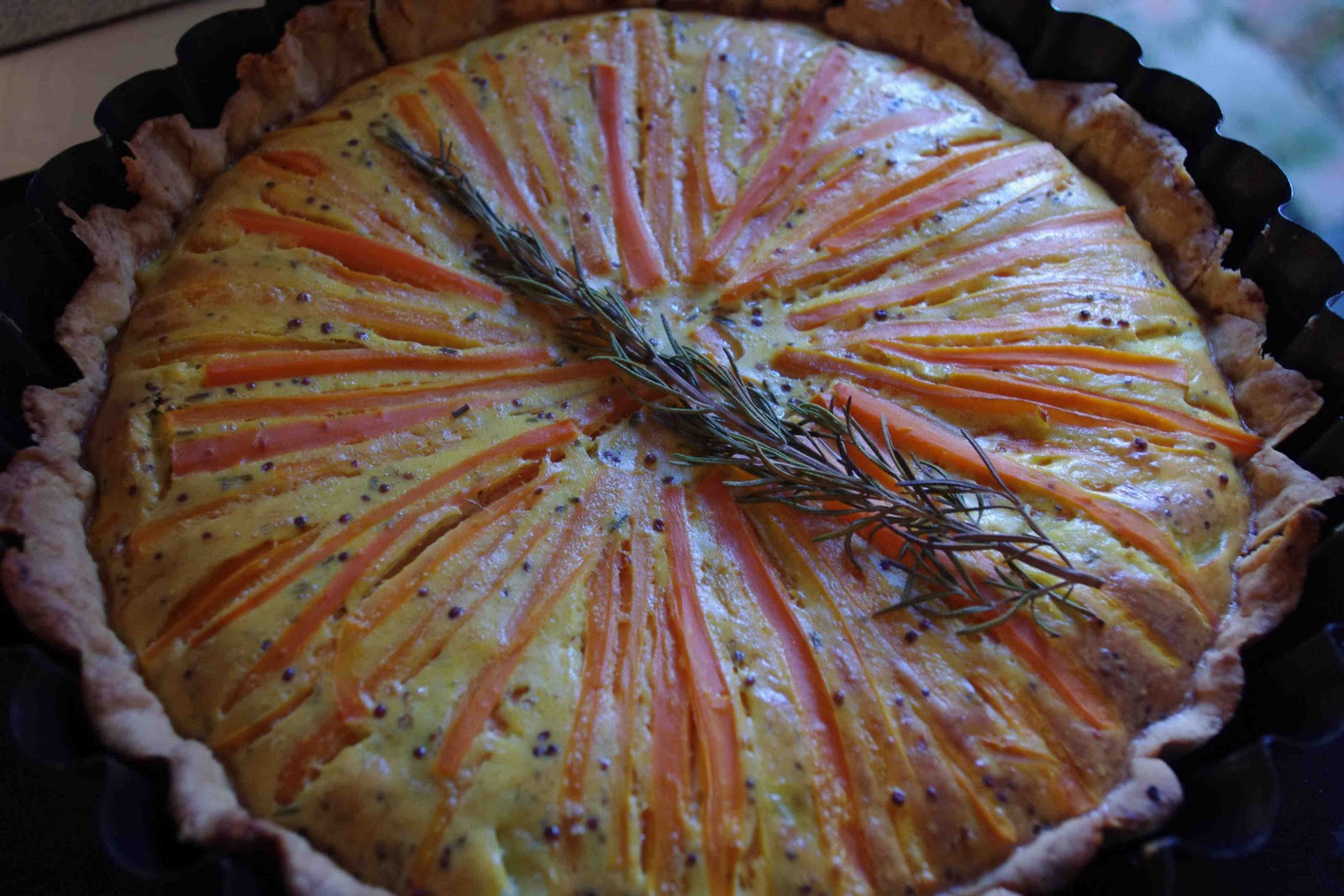
Frockmaking and mustard carrot-and-leek tart


So it was Labour Day, and the Quiltmaker and the Tall Designer and I had no work to go to. The Quiltmaker decided to make herself a frock, and the Tall Designer decided to make his girlfriend a frock. On the very same day.

As neither of them had made a frock before, they convened for mutual support at the Quiltmaker’s charming home – it has a cellar and everything – and (as I have popped my frock-making cherry) they invited me along in case trouble was run into, and also because I’m the proud owner of an eBay-won Babylock that beats zigzagging seams by a million miles as long as you don’t get a chunk of the garment caught in its cruel blade.

In keeping with the wholesomeness of it all, the question had been raised of how best to sustain us through the day. The occasion was risen to superbly, with the Quiltmaker’s sylvanberry and chocolate-chip mini-muffins and the TD’s huge wedge of brie with seedy crackers. I chipped in Gérard’s Mustard Tart, from p54 of Dorie Greenspan’s mighty Around My French Table.

I have made this tart before, both versions – the traditional Dijon tomato version is a winner too. It has a great tart crust, which can easily be made in double quantity and a flattened disc of its dough clingwrapped and frozen for another time (such as this day turned out to be), and for all sorts of other tarts for that matter. And it’s not every day you get to celebrate mustard as a chief ingredient. It’s just right – not overpowering, but definitely speaking up for itself.

The first time I made this version, following the instruction to prepare the carrot and leek in batons to radiate prettily from the centre caused the more resilient strips of leek to mess up the slicing a bit, and they wouldn’t quite be bitten off either, coming away inelegantly all in one piece. This time I cut the leeks in inch-long lengths, leaving the carrots to play the part of the sunrays.

I also increased the filling quantity quite a lot to fill more of the tart shell – I made it 5 eggs rather than 3, and 3 bulging tablespoons each of Dijon and wholegrain à l’ancienne mustard rather than 2 proper levelled ones. It’s a very forgiving recipe; I had only a scant few tablespoons of leftover whipping cream rather than the called-for 6 of double cream or crème fraiche – which I would have otherwise more-or-less doubled, given other increases – but no harm done.

On the frockmaking front, no trouble of note was run into and by dinnertime both frocks were at trying-on stage, which was extremely good going on both their parts. Neither pattern was the most straightforward, especially the Quiltmaker’s Amy Butler Lotus Dress, but she was undaunted by the puffed cap sleeves and took up the gathering with relish, and the challenge paid off with possibly the cutest frock known to humankind. The TD’s elegant frock with its neckline tucks and darts and shaped shoulder straps was well served by his precision, and its handstitched hem was a delight to behold; unfortunately his GF was overseas and couldn’t try it on, but we felt confident in the complex calculations of her measurements gleaned over Skype with the aid of sheets of folded A4 paper.