Showing posts with label brownies. Show all posts

Sunday, 11 December 2011

Gingerful biscotti


It’s nearly Xmas, which I am very bah-humbuggy about, but I admit that it allows great scope for the foodish aspect of life. I’m not sure why ginger-related things are very often also Xmas-related, but as I’ve had a bag of crystallised ginger taking up precious cupboard space for some months, I’m prepared to take this opportunity to use it up as a nod towards the season. After all, I like ginger, and I’m looking for recipes that take it beyond a spoonful of bland dry ground stuff and into the chewier, sharper crystallised realm.

I had the idea that chocolate and ginger would play well together, which led me on a search for ginger brownies. Dorie Greenspan has Ginger-Jazzed Brownies in Baking, but they only have ground and raw in them – appealing, but not of much relief to my cupboard-space issue, so I’ll do those another day. I was amazed that I found so few brownie recipes involving crystallised ginger – there were only a couple on obscure websites such as this one, and packet mix was involved. So I imposed ginger on a basic good brownie recipe as a replacement for walnuts. Since I’m not recommending it to anyone, I’m not even recounting the method here. And I didn’t take any photos – the bits of translucent golden ginger failed to stand up to the dark chocolate brownie in cross-section.

I can’t quite figure out why it wasn’t on the money. Was the chewy texture of the ginger not enough of a contrast to the fudginess of the brownie? Did the ginger and the chocolate remain two separate parts in terms of taste that didn’t form a pleasing whole? (The poor Saucemaker would concur with this – she was nibbling on her piece and getting along with it okay until she came to an unexpected bit of ginger and was deeply disconcerted.) I love bits of crystallised ginger enrobed in dark chocolate and sold in fancy shops, but clearly this doesn’t translate to a cakier context.

Anyway, so I moved on to Maida Heatter, whose Gingerful Biscotti (Maida Heatter's Brand-New Book of Great Cookies, p20) are the Xmas favourites of many on Egullet and Chowhound. These were more like it. Pleasantly bitey with the extra kick of white pepper; not overly sweet, not overly rich or luxurious, but that’s probably all for the best and allows for the less-guilty grabbing of handfuls.

120g crystallised ginger
200g raw almonds
375g plain flour
3/4 teaspoon bicarb soda
3/4 teaspoon baking powder
1/4 teaspoon salt
1 1/4 teaspoons freshly ground white pepper
1 teaspoon ground ginger
1/2 teaspoon ground cinnamon
1/2 teaspoon ground mustard powder
1/4 teaspoon ground cloves
100g sugar
3 eggs
1/2 cup honey

Cut up ginger into bits the size of peas; set aside. (Maida comments rather acidly and uncharacteristically that ‘Yes, cutting ginger is boring.’ This seemed curious, as I can think of many tasks I find much more boring and onerous than spending about 30 seconds chopping up soft ginger.)

Toast the almonds in the oven at about 180C oven for 15 minutes, until lightly coloured, shaking once during toasting. Don’t forget about them, as I almost always do in an out-of-sight-out-of-mind fashion until the reek of charring almonds breaks through my haze of preoccupation. Even slightly burnt almonds taste ghastly, second only to hazelnuts, which one often thinks one has escaped with as one rubs off their burnt skins and exposes the pale nut beneath – but alas, they burn to acridness deep in their hollow middles. Anyway, set your perfectly toasted almonds aside to cool.

Into the Kitchen Aid bowl sift the flour, bicarb soda, baking powder, salt, pepper, ground ginger, cinnamon, mustard, cloves and sugar, and beat together. Stir in the crystallised ginger, then the almonds. Separately beat the eggs with a fork and add the honey, then add to the dry ingredients. Stir until the dry ingredients are completely moistened.

Place two 40cm lengths of cling wrap on a work surface and form two strips of dough down the middle of each. Spoon half of the dough by heaping tablespoonfuls in the middle – down the length – of each piece of plastic wrap, to form strips about 30cm long. Flatten the tops slightly by wetting a large spoon into water and pressing down on the dough with its back.

Wrap the dough, and press on the plastic wrap to smooth and shape it into an even strip about 35cm long, 5cm wide and 1.5cm thick. Place the wrapped strips strips of dough in the freezer for at least an hour or until firm enough to unwrap (or as much longer as you wish, like days and days until the craziness abates long enough to allow you to be home and available to the oven for a few hours while frantically tidying the worksite midden that was once your house because people are coming over. By the way, this is currently and seemingly eternally the outside of said house).

To bake, adjust two racks to divide the oven into thirds and preheat oven to 160C. Line two large baking trays with silicon liners or baking paper, and place the unwrapped strips diagonally across them, or however they fit. If your trays are big enough you might be able to lay the two strips side by side on only the one, but remember they’ll spread a bit. Bake for 50 minutes, reversing the trays top to bottom and front to back once during the baking to ensure even baking. They’ll turn quite dark.

Reduce the temperature to 150C and remove the tray/s from the oven. Although hot, carefully and gently peel the paper away from the backs of the strips and place them on a large cutting board. Slice into 1cm strips with a serrated knife while they’re still hot, using a tea-towel to save your steadying hand if you like. Slice on an angle; the sharper the angle, the longer the cookies, and the more difficult it will be to slice them very thin without the ends breaking away – happy days. At least this makes a lot, though: 70-something.

Place the slices on a cut side down on the trays and bake for about 25 minutes until the cut side is golden. Reverse the sheets top to bottom and front to back once during baking. Bake just until dry. (You have to cool one to know if it’s crisp.)

When done, cool and then store in an airtight container. They’ll keep for weeks. Pretty please, either dunk them or prepare to face your dentist – they’re seriously as hard as rocks, and I can’t imagine why they never come with a warning in recipe books. As a long-time bruxist who must now wear a mouthguard (I know, hawt) to bed for the rest of my days or at least until I get dentures, I’ve got sensitive incisors with edges described by my dentist as ‘like glass’, but still.

Tuesday, 11 October 2011

Rosemary Blondies – a guest post from The Labyris Bearer

The Labyris Bearer is a woman who relishes a challenge. (This may be why she was earliest of us all to adopt the Bourke Street Bakery Cookbook, not to mention trap possums and go to Iceland during Eyjafjallajökull and many, many other challenges.) So when I washed my hands of a baking failure which happened to taste fabulous, The Labyris Bearer thought it worth resurrecting the flavours for another shot and, thanks to her tenacity and analytic approach, transformed them into something all her own, something fabulous and rich and caramelly and just right. I might have had four. 

In a special guest appearance, I give you ... The Labyris Bearer!
Macarong recently produced the most delicious…cookie-things. Unfortunately their texture and appearance were not perfect. One co-worker unkindly but accurately described them as ‘like pools of cat vomit’ [Macarong: Take a bow, Quiltmaker!]. So we decided to try to improve the recipe. My first attempt was more floury, so stood up instead of pooling, but it also fell apart; at this point I gave up on biscuits, and decided to transfer the pleasing flavours into something better suited to such a texture

At about this time, I discovered that my culinary hero, Anthony Telford, author of the wonderful The Kitchen Hand, had done a cookbook: The Basics: A really useful cookbook. This is truly ‘the only cookbook you will ever need’. I found his chocolate brownie recipe (p.346), which, of course, in the ‘Hints and Tips’ that accompany every recipe, gave directions for the white chocolate version, the Blondie. Simply adding the finely chopped leaves of four sprigs of rosemary produced the richest, most delicious, perfectly slightly-gooey-inside slice.

250 g white cooking chocolate
250 g unsalted butter
5 eggs
500 g castor sugar (I used half light brown sugar/half castor)
1 tablespoon vanilla essence
200 g plain flour (wholemeal or wholewheat works well)
½ teaspoon salt

1.       Preheat oven to 170oC. Lightly grease and line a large slice tray with baking paper.
2.       Place the butter and 200 g of the chocolate in a heatproof bowl over a saucepan of simmering water. Reduce the heat to the lowest setting. When melted, set aside to cool slightly. (Not too long: it kind of coagulates and cannot be made to mix together again. Doesn’t seem to affect the cooking, but it just looks less pleasing as you’re making your blondies.)
3.       Beat the eggs, sugar and vanilla with an electric mixer for about 10 minutes or until light and fluffy.
4.       Beat in the cooled chocolate mixture, sift in the flour and salt, add rosemary and stir until well combined.
5.       Beat in the remaining 50 g white chocolate, chopped into small pieces.
6.       Pour into the prepared tin, place in the oven and bake for about 35 minutes. A skewer inserted in the centre should come out with some mixture still on it. Remove from the oven and cool on a wire rack; if it drops in the centre and forms a cracked crust, then you have just made the perfect blondie.

Due to the white chocolate, these are not only totally delicious and more-ish, but also sickeningly wickedly – sweet and rich. Only the addition of rosemary makes them into something that can be served to adults! Most people have difficulty guessing this mystery ingredient.

But to return to Mr Telford’s The Basics: as you can tell from the recipe above, these really are basic straightforward recipes of everyday foods that anyone will have encountered growing up in Australia. There is not a single picture in the book. There are 471 pages of recipes, followed by almost 100 pages of the A–Z ‘Really Useful Information’ that first appeared in The Kitchen Hand (e.g. three pages about salt; four pages about rice and its cooking). Then info on food allergies and intolerances, with tips on substitutions; complete list of food additive codes; cooking techniques explained (such as BBQing, microwaving, steaming); preserving; conversion and equivalency tables – THE LOT for anyone who wants to learn to cook.

Rather like an updated and greatly expanded CWA/Presbyterian Womens Cookbook, this really is a book that beginner and experienced cooks will use and enjoy browsing through. The PERFECT moving-out-of-home present for young people.

Sunday, 27 February 2011

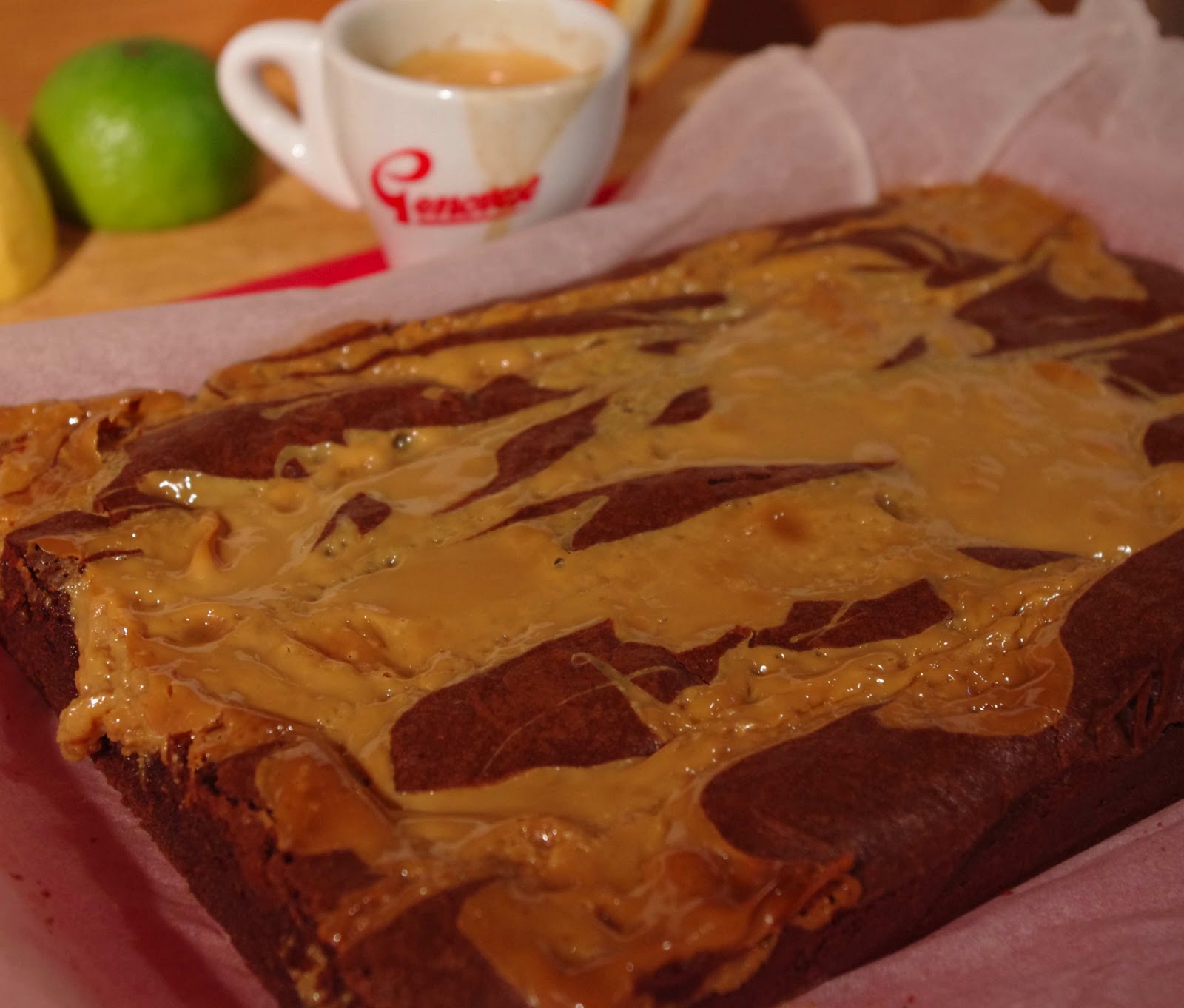
Dulce de leche brownies


I love these brownies of David Lebovitz’s. Compared to macarons, they’re a walk in the park, and sometimes that’s what’s needed when one really sucks at French and needs to set aside precious Sunday time to study so as not to appear such a loser in class the next evening, and when one has suddenly taken it into one’s head to start a blog, the set-up of which has somehow eaten up most of the day. But I digress. I do that a lot. The whole thing making brownies, that is; back on track now   takes about ten minutes from start to oven, assuming one’s prepared several tins of dulce de leche earlier, as one ought to have done. I hold forth about such preparation in another post.

Contrary to how most posts to come will roll, this was not my first dulce de leche brownie encounter. That was last week, when I made a couple of batches one to take to my work, where they were assured of a warm reception, and the other dispatched with The Guitar Teacher to be left in his staffroom. TGT resisted, claiming it ‘wasn’t part of the culture’, but I pooh-poohed such silliness and he admitted they were all gone by day’s end, so I win.

First hitch came when I found that there was almost nothing left of the Droste I bought mere days ago. I figured half of a quarter-cup was close enough, and bumped up the flour and real chocolate quotient slightly. No harm seemed done.


(It’s only right to disclose I have started blogging this rainy Sunday due to the opportunity for inclusion of boldly cropped close-ups. Just want to try out the macro setting on my Pentax Kx, to be honest. Nothing else to see here. If I really get into the swing of this, French linen may be artfully crumpled in the near background. And yes, I’m aware that this pic may not be key to the procedure, thank you very much, but I bashed my right temple very hard on the corner of the cupboard while angling to take it, so here it is.)

Anyway. The ingredients are flung into a saucepan and melted and stirred together. No need to have the foresight to let cubes of butter come to room temperature of their own accord while trying to keep the cats from eating them.

The ingredients form a gloopy, glossy mess of impeccable rightness. Half is spread in a tin, globs of dulce du leche distributed on top, and the process repeated. I found it best not to mix too much beyond drawing a knife lightly up and down the pan a few times to streakify the caramel a bit – the integrity of the globs is worth a thousand tiny strands of golden almost indistinguishable from the surrounding brownie. I didn’t bother with the optional walnuts, feeling this to be a less-is-more thing. Walnuts’d only get in the way; they’d try to claim some of the stage rightfully occupied by the sticky chunks of caramelised condensed milk goo.

As usual with my quirky oven, the maximum recommended baking time still produced a central wobbliness more uncooked than sexy. Even though I’d bumped up the oven by ten degrees, and a thermometer supported the temperature. I may never discover why this is. 


Yeah, I cut the end off well before it cooled. What of it? The caramel did crack, and the brownie crumb may have been crushed, or squashed, or whatever is supposed to happen to it in such an event, but goddammit, it was high coffee time.