Tuesday, 3 May 2011

New York institutions


It might take the Guitar Teacher some time to forgive me for dragging him from the culinary delights of Smith Street Brooklyn to Yonah Schimmel’s Knishery on the Lower East Side for our first lunch in New York. But I told him this place has been something of a legend for about a hundred years, and I was a knish virgin, and it had to be done.

We found that a knish is basically a $3.50 grapefruit-sized ball of mashed potato encased in a thin papery dough, and more or less devoid of texture and flavour. It was heavy going, especially the kasha (buckwheat) version. The plastic cupful of cold borscht was more familiar ground, but there was clearly something we weren’t getting about the whole experience. After we’d forced our knishes down, we belatedly noticed the array of mustards on offer and realised that was the sole road to flavour.

It was incredibly cheap and carbful and stick to the ribs for hours and hours, which I might have welcomed more in 2003 when travelling as a student even poorer than now. We made our way to another institution, Café Gitane, afterwards, but found ourselves too bloated to muscle through the crush.

Another reason local Yelpers often give for their love for Yonah Schimmel’s is its resistance to gentrification, so as one tenant-not-homeowner watching askance the relentless progress in Smith and Gertrude Streets, I can understand this too. It looked as if it were untouched since the thirties, and it was hardly a sleek outfit even back then – it was tiny and dingily lit, lined with ageing photos of celebrities who had eaten there, and it had a dumbwaiter. I need to give it another go if there’s a next time; there must be a way into knish nostalgia.

The GT was happier with me the next morning when I dragged him to Amy Ruth’s in Harlem for some soul-food, being virgins in this regard too. He was pleased with his frisbee-sized waffle with its mountain of fried chicken. I had a waffle with a soupbowl of blueberries, smothered in maple syrup. Unfinishable.

 Here’s a picture of Katz’s Deli. 
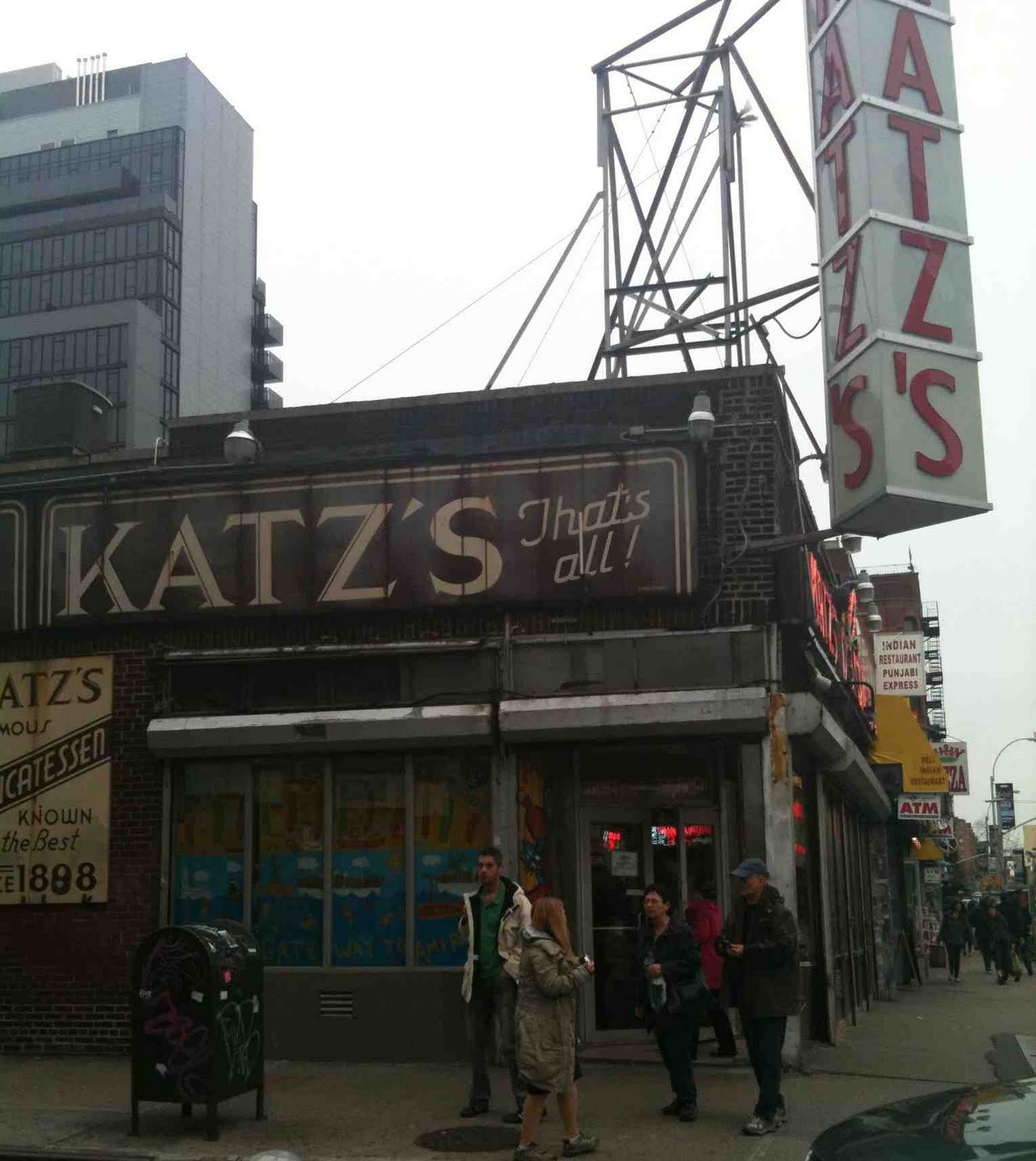

We tried for a famous pastrami sandwich at Katz’s, how we tried. We even got far enough inside the front door to be ticketed and hustled along by two guards. But there must have been a hundred people lined up in there, and there was the complicated ticketing system, and we were starving. And the guards. And those tickets. In a restaurant. So we left and backtracked a block to a checker-floored vinyl-boothed diner called The Remedy.

There we had a sangwich each – also unfinishable. My pastrami version looked like a joke version of itself – it must have had a dozen chunky slices of pink meat in it and stood about six inches tall on its skewer, alongside a pickle and coleslaw. The taste was a bit lacking and one-note despite all that, and the half I did get through sat in my stomach like a brick. And I’m a big eater, and love eating.

Look, I don’t get the serving sizes thing; much as I’d heard tell of it before I went to the US, I found it pretty confronting and somehow a bit disturbing. Is it some sort of competitive insistence of value for money, or an unconscious statement about largesse when elsewhere in the world the volume of that sandwich would feed a whole family for several meals?

Monday, 2 May 2011

Kyoto: the best of the rest

Kyoto. Food. Mwoah. From the breakfasts of brewed coffee and crustless sandwiches and salad at lovely Teramachi cafe in the Sanjo-dori covered arcade to the seaweed-wrapped delicacies on offer at the airport. Okay, the taste of the crab miso from off the ¥137 sushi train took a few hours to go away, but even the infamous natto I dared to have at Asuka alongside their famous pile of tempura wasn’t that bad. (I was dying to know how bad it could be, ever since Sean McAllister in Japan: A Story of Love and Hate likened eating rotting soybeans in raw egg to eating a bowl of snot.)

Teramachi Coffee
 There was Ippodo, purveyors of the best matcha available to humankind. I also got some genmaicha because I liked the tin and the dark wood-beamed shop and the bustling women in fetching aprons and caps. 


There was beef curry at  Honyaradō , a timbery book-lined institution among uni students for thirty years, and thus more about the ambiance than the cheap, hearty food. There was the lunch niju bento at Uosue.


And the most incredible grilled unagi at Kaneyo, and teriyaki skewers loaded with anything from chicken-neck skin to duck breast at Torito.


 There was Café Bibliotec Hello!, a café mashed together with a bookshop and gallery in a hollowed-out machiya that took several goes to find – the Lonely Planet area map marked it wrongly, I’m sure of it, though I seemed to be very challenged generally finding places in Kyoto, even accounting for the frequent lack of street signs. I’m glad we persevered, though it wasn’t until the last day in Kyoto we found it – and then only for uncommonly excellent espresso, which we drank at a low fifties coffee table by a glowing globe of the world.


 There was scotch available in vending machines at every corner. There was this metal-bead-festooned pub selling Guinness  – or rather there wasn't, since it was shut when we discovered it and then we could never find it again.

There was a green-tea sweet to go with the bowl of matcha at the tearooms of the Murin-an villa in northern Higashima, leading to an uncontrollable compulsion to pay ¥1600 for a box of them. As with an almost identical experience at the Urasenke Chadō Research Center, the woman kneeling in her full kimono to present the tea cupped in her two hands then slowly bowed until her forehead touched the tatami mat between us, and I had no idea what to do in response – exactly the same, or a halfway bow, or nothing? I sort of cringed and smiled and nodded, for all the world like a gauche Westerner. Also at the villa a wedding-photo session was taking place, which was further grounds for embarrassment – I'd taken off my worn, battered Camper boots at the tearoom entrance, and along had come the exquisitely gowned couple and seated themselves on the steps right next to them. And the photographer had covered up my footwear with a couple of parasols, and was busily photographing away. I waited and waited in my socks, and still it went on. Eventually I darted in while the couple were being rearranged slightly to retrieve them, muttering gomen, probably risibly inappropriate to the situation, and the doll-like bride looked me up and down bemusedly. 


Bamboo izakaya


I had some idea of an izakaya as being a very traditional sort of Japanese pub, stolid and down-to-earth and full of venerable men kneeling on mats around battered ancient floor tables, something like a fish-and-Asahi-oriented version of the Renown before it was cleaned up and became the Gertrude. Well, was I wrong. So wildly incorrect that, ravenous, bone-chilled and aching from a day of riding bikes around Kyoto, we searched several blocks of Sanjo-dori high and low before it dawned on us that the sleek place with all the bamboo out the front must be it. 
 
The only seating was at a bar lined with big sake bottles, overlooking the dexterous young chefs. Delicious aromas wafted up as each plate was prepared. After my curiosity-driven sweet potato shōchū there followed lots of headily warm sake, which went down with extreme ease. Its containing jug, like a lot of the earthenware here, seemed inspired by body organs.

For a long time we were the only people there, until a few lone women drifted in one by one and seated themselves at points along the bar to chat to the staff. A handwritten English menu was unearthed for us and we pointed to about half the listings, so hard was it to resist anything. It came out in small plates for sharing, tapas-style, each one a little work of art.

The yuba was a particular revelation – fine, silken layers of tofu skin in some sort of benito broth, which was akin to eating a stack of cooked lasagne sheets, as strange as that may sound. I’ve dreamed of its ungraspably subtle taste and texture ever since.


Sunday, 1 May 2011

Nishiki Market in photos


We gathered up anything that looked interesting, and, if not eaten on the spot, took it all back to eat in the communal kitchen of our ryokan along with a longneck of Asahi from the fridge. And it was all delicious.


Trip


It started with this…


… and ended with this.


 While I warm up to using some of this haul, I’ll round up some good eating that was had in Kyoto, New York and San Francisco.

Sunday, 3 April 2011

Green tea and black sesame macarons


I had several reasons for spending far too much precious time making macarons today:

1)   procrastination
2)   imminent departure for Japan (provided we don’t get bumped again, for then I should give up rearranging my carefully laid plans and take to a darkened room instead of beating my fists against Acts of God and sending several of Flight Centre’s International Travel Consultants on stress leave) where they use such things as matcha and black sesame – why yes, you’re right, that is a flimsy connection
3)   procrastination
4)   the discovery that all the little plastic containers taking up space in the freezer added up to 18 egg whites, thanks to my recent ice-cream-making obsession
5)   procrastination
6)   I named my blog for them, and what do I have to show for that so far?
7)   procrastination

I’ll briefly run through my method for this; thankfully no one reads this blog in order to be mislead – to skip to the end and get it out of the way, these didn’t work and I don’t know why. 

Green tea version first. Sift 110g icing sugar, 70g almond meal and 2 tablespoons matcha into a bowl. I’m no greater fan than Nigella of sifting, but concede it’s best not to skip this step – the almond meal especially usually yields a half-teaspoon or so of not-so-fine meal that needs to be discarded lest it roughen the surface of the macaron. If only that were the extent of the macaron’s worries.

In an electric mixer, whisk 100mL eggwhite* and a pinch of salt until stiff. Add the teensiest bit of green food colouring – I jabbed a wooden skewer into my Wilton gel and used what came away on it, that’s how miniscule I’m talking. That pack of colours will see me out, I think.


 *100mL = 90g or about 3 whites. Probably about 5 tablespoons, although it’s very difficult to measure whites that way – there’s always a glutinous chunk that likes to slip out and take the level down with it.

Re-sift the sugar/flour/matcha over the bowl of whites and gently fold in until the mixture has achieved a magma-like consistency. Fill a piping bag fitted with a 5mm nozzle and pipe as best and consistently as possible onto a silicon-lined tray, as if creating little snails, flicking back the nozzle at the last instant to avoid a snail with a … tail. 

 This is where I go so very wrong, time and again. I’ve watched Youtube clips, I’ve read up, I’ve steadied my hand, I cannot get the uniformity of circle I so want. And because I have a crappy small oven that only takes a tray of meagre size, I fall into the trap of putting them too close together – they will spread a bit, and often do as they rest. 

In spite of having been in this pickle before, I did the same again today and then thought better of it and scraped the ones most at risk of colliding back into the piping bag with a spatula, in the process injuring the adjacent ones and sending them the same route. Wrong, wrong, wrong.


I also chopped up some vanilla sencha and sprinkled that over them. 

Then I did the whole thing again for a batch of black sesame macarons, with about quarter of a cup ground black sesame seeds instead of the matcha. And no food colouring.


 The tray of circles or ovals or whatever then sit until their surface can be very lightly touched with the tip of a finger and not come stickily away on it. How long this takes depends on how warm and humid it is – a lot of recipes talk about half an hour, but I left these all day before they passed the touch test.

And then there is the baking of the macaron ...

So anyone anywhere with anything to say about macarons agrees that it’s a 150 C oven for 10–11 minutes. No more, no less. Well, that does nothing for mine. I bump it up to 170 and it still needs almost half an hour before any kind of hardening of the surface starts to happen. So I grow bored and walk away, and then they’re lightly browned, quelle horreur. And it gets worse.

THEY LACK FEET.

In fact, they’re nothing but flat discs with too much crunch. How do they not have feet? I don’t know the answer – I’m none too clear on how perfectly made macarons do form feet.

This lot are actually the worst macarons I’ve ever made, worse even than my first attempt. I really could do with one of those fabulously expensive weekend macaron workshops.

And there it is. Sunday Fail Part II.

I was loath to waste a perfectly good ganache on these sorry specimens, so I knocked together a buttercream filling with another 2 eggwhites, 100g castor sugar, 170g butter and some vanilla extract. The resulting sandwiches did have a good taste – the degrees of matcha and black sesame seemed okay, not too overpowering or subtle, so I might try these again. One day.

Saturday, 2 April 2011

Silverbeet and spinach pie


 I set out to make spanakopita, but didn’t have filo or pastry or feta or sesame seeds, so sort of made this up from bits and pieces of sources, mainly Stephanie Alexander’s Crustless Spinach Pie in Kitchen–Garden Companion. Here it is, in its stages. It’s like lasagna, I should tell you first – it seems straightforward enough, yet by the time it’s in the oven you realise you just spent most of Saturday afternoon in the kitchen. Still, it’s a good slice-up-and-freeze-the leftovers option.

First thing I did was ditch the crustless aspect, referring to the flan pastry in Michel Roux’s Pastry. How can a pie be allowed to lack a crust?

500g plain flour
250g cold butter, chopped into bits
2 teaspoons castor sugar
½ teaspoon salt
2 eggs
80mL combined water and iceblock

Put all ingredients except the water in the KitchenAid, and combine with a dough hook on slow speed until grainy-looking. Slowly add the ice water until it all clumps together. Scrunch it all together in the mixing bowl a bit, and divide in half. Shape the halves into flattish discs, wrap in cling wrap and refrigerate for at least half an hour.

Sorry if I just tricked you into making a double quantity – it’s true that only one disc is needed for this here recipe, but why not make another for future reference with no more trouble? It’ll keep in the fridge for a few days, or freeze against the winter. It can be used for most pie situations that call for a nice rich buttery crust.

After it’s chilled and rested, roll out on a floured board and line a greased pie dish. Stab it with a fork and line with foil before pouring in pie beads or split peas and blind-bake for 20 minutes at 180 C. Remove the baking weights and bake for another five minutes. Set aside to cool.

2 onions, chopped
several cloves garlic, chopped
bunch silverbeet, leaves shredded (save stalks for a gratin or soup)
bunch spinach, leaves shredded
Soften onions and garlic in a little olive oil over a medium heat, add silverbeet and cover for 5 minutes until wilted a bit. Add spinach and stir until it’s all cooked. Leave to cool. Add dill. A little dried mint is another good addition I didn’t think of until now.

500g ricotta, give or take
3 eggs
grated nutmeg
salt and pepper

[gratuitous unmoulded ricotta shot, thank you for your patience]


Mash all this together in a bowl as thoroughly or roughly as you like (personally I like to come across the odd chunk of ricotta when slicing the pie) and combine with the greens. Pour into the prepared pastry case. Sprinkle over:

chopped kalamata olives
lightly toasted pinenuts
grated parmesan [whatever quantities you feel like for all these]

Cook at 180 C for about half an hour until there are browned bits on top.